Vineyard going green or turning yellow?
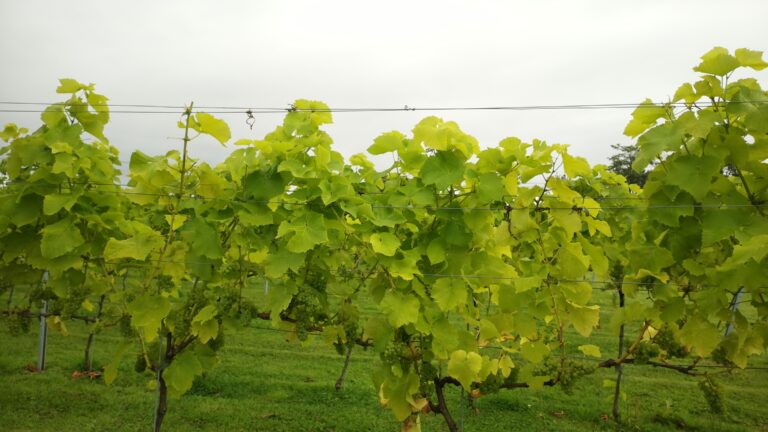
Vineyard managers can’t change the amount of sun or rain that their vines receive but they can ensure that vines extract the maximum amount of energy from the available sun’s rays. Latest results from the South Wales Llanerch Vineyard trial demonstrate how to accurately measure the leaf pigments and rapidly determine when to apply additional nutrition and when to stop. Corbeau Innovation’s new Leafbox leaf analyser was used to quantitatively measure chlorophyll and carotenoid pigments used in photosynthesis. With accurate GPS location it was also possible to provide parcel averages for each variety in the field and an overall map of leaf pigment concentrations in the field.
Benefits
When vines extract the maximum energy from the available sun’s rays, they have the most power for growth, cropping and disease resistance. Vines use solar energy to chemically manufacture carbohydrates: cellulose, pectin and lignin for growth; glucose, fructose for fruiting and sucrose for transport; and more complex carbs to provide physical and chemical barriers to invading pathogens.
Challenge
Back in the early days of the agrochemical revolution, emphasis was placed on increasing plant growth and yields by applying huge amounts of N:P:K chemical fertilisers with little thought to the long term effects on fields or their surrounding ecosystems. Today farmers are increasingly choosing regenerative approaches which focus on the long term health of the soil and the field ecosystem. This often involves companion planting, use of cover crops and minimal use of heavy tractors in the field. As a result, regenerative farming can take 3-5 years to achieve an efficient, ecological balance in a field. The commercial challenge for vineyards is to find a symbiosis between intervention and non-intervention so that the health and productivity of perennial vines are maintained while soil structure, microbiome and ecology are progressively improved.
Trial Solution
The Llanerch Vineyard field trial was started in 2024, with Leafbox leaf pigment measurements typically made every two weeks when the vines were in active growth. The 1.4 hectare north field was chosen as the location for the trial. It is planted with three parcels of cropping Phoenix, Rondo and Solaris grape varieties. The same protocol was used for both 2024 and 2025 Leafbox measurements at Llanerch Vineyard.
The protocol consisted of leaf pigment measurements of 40-60 mature leaves taken from the top of the vine canopies. Leaves picked were therefore in full sun and 1.5 to 1.8m from the ground. Whole leaves, or larger leaves torn in half by hand from petiole to tip, were imaged in Leafbox so that genuine leaf average pigment levels could be determined. Every third or fourth row in the field was walked and leaves were sampled towards the ends of rows and in the middle of rows. Following this protocol, scouting the field took around 45 minutes to complete.
Leafbox calculates chlorophyll and carotenoid pigment concentrations in 10 seconds in the field without the need for internet connection. Pigment units are equivalent to micromolar [μM] solution concentrations. Vine leaves typically have leaf chlorophyll concentrations from 35 to 65 units and carotenoids concentrations range from 18 to 22 units. Repeated measurements of the same leaf show a measurement standard deviation of 0.7 units.
When the field scouting was complete, the Leafbox images were uploaded to the Corbeau cloud platform. Corbeau uses AWS cloud computing to calculate all Leafbox measurements from individual days, to chart varietal parcel pigment levels and display whole field interactive images of leaf pigment distributions. Field images show both individual vine leaf measurements and interpolations for whole fields.
Results
Parcel averages from June to August (see below) show significantly different chlorophyll trends in 2024 and 2025.
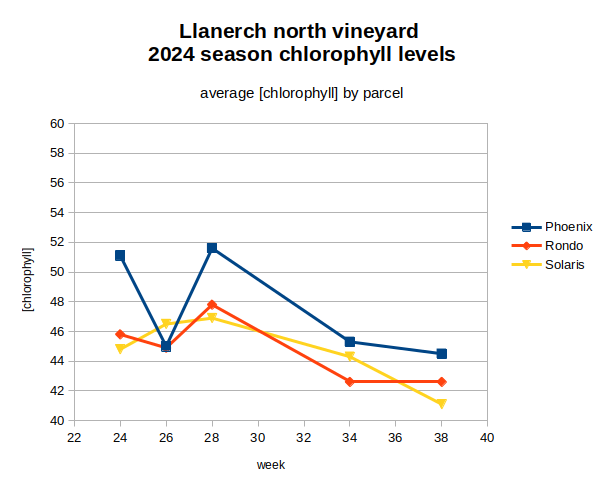
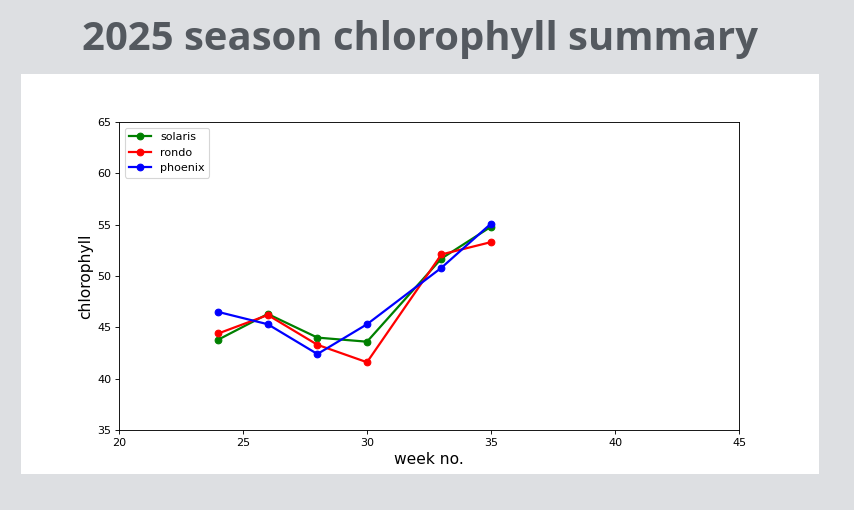
Chlorophyll levels dropped progressively through the 2024 growing season and finished at around 45 units. During the winter a mulch of well-rotten manure was applied under the vines as part of long term measures to improve soil health without using chemicals. However at the start of fruit setting in week 24 in 2025, measurements with Leafbox showed no real increase in chlorophyll levels in canopy leaves. Subsequent Leafbox measurements up to week 30 showed levels of chlorophyll dropping to the low 40’s, following the same trend as 2024. Optimal chlorophyll levels for most vines are in the mid 50’s therefore a strategic intervention was planned.
A fast-acting foliar feed was applied twice between week 30 and week 35 and immediate improvements were seen in all the varieties. Phoenix and solaris vines showed the highest chlorophyll leaf concentrations at around 55 units while the rondo vines were not far behind those values.
Each Leafbox measurement also has an accurate (90% +/- 2m) GPS location, so Corbeau’s platform can provide not only varietal averages but also pigment maps for whole vineyards. Chlorophyll maps for 2024 and after the foliar feed intervention in 2025 reveal the big picture of the north field planting.
There are two major uses of chlorophyll mappings: first to plan longer term regenerative management over the winter and early spring; and second to make targeted interventions when the vines are growing and fruiting. It is feasible for example to use GPX files to guide application of nutrition by tractor or even field walking with a mobile phone and knapsack sprayer. It is also possible to apply selective nutrition by drone spraying.
Conclusions
Over two seasons in the vineyard it has been possible to demonstrate quantitative leaf pigment measurements with the Leafbox instrument. Leaf pigment concentrations, specifically chlorophyll, were used to monitor the capacity of three different varieties of vines to capture and use energy from the sun. This year it was possible to make timely nutrition interventions, applying foliar feeds to increase the energy capacity of the canopies of all three piwi varieties.
With the benefit of geo-located quantitative pigment measurements, the success of longer term regenerative measures can be determined as the vines grow. At the end of the growing seasons, additional longer term vineyard management can be considered and directed towards specific vines, parcels and areas of the field that need improvement.
The first steps have been taken to show that new technologies like Leafbox can direct minimal nutritional interventions at just the right time, while also supporting moves towards long term sustainability.
Acknowledgements
Corbeau is pleased to acknowledge the valuable collaboration with field trial partners Llanerch Vineyard.